How to secure a holding company licence in Dubai 2026: 12 essential steps for seamless setup and ownership
How to secure a holding company licence in Dubai 2026: 12 essential steps for seamless setup and ownership
Navigate Dubai's updated regulations for holding company formation, including board setup, capital requirements, and prohibited activities like direct trading or manufacturing to own subsidiaries, real estate, and intellectual property efficiently.
Vincy Amirtharaj
58 post
Senior Business Setup Consultant, Dubai
Dubai is amongst the most beneficial business hubs as of now. Investors and family offices are looking to secure a holding company licence in Dubai as a tax-efficient way to manage subsidiaries and investments under a single corporate umbrella. A holding structure operating in this leading international financial centre offers more than just 100% foreign ownership. It stretches to provide a critical layer of asset protection for real estate portfolios, intellectual property (IP) and subsidiary shares. The city’s legal environment is now calibrated for cross-border wealth preservation, whether you plan to structure a Special Purpose Vehicle (SPV) in DIFC or a standard free zone investment vehicle.
The Emirate's tax environment renders holding company structures particularly attractive in 2026. The "Participation Exemption" regime under the updated UAE Corporate Tax (CT) by MoF now allows qualifying holding companies to take advantage of 0% tax on dividends and capital gains. Added advantages like access to around 137 Double Taxation Agreements (DTAs) and tax certificates for tax residency make the UAE even more attractive for holding structures. Integrating a Family Office or Foundation model for holding private wealth can further help with succession planning and bypass complex probate procedures.
This guide explores in detail all the nuances around obtaining your holding company licence in Dubai. Read further to find out more about choosing the right jurisdiction, meeting Economic Substance Regulations (ESR) requirements and passing banking compliance checks.
Establishing a corporate foothold for your wealth management strategy is much easier and more streamlined in the year 2025 with Dubai unveiling its next-generation version of the Invest in Dubai (IID) platform.
Typical 6-week setup & banking timeline
Week
Authority / Task
Key output
1
Compliance Check
KYC & Source of Wealth clearance ✓
2
Registrar (DET/FZ)
Initial approval | Trade name reserved
3
Signing
MoA signed (Digital or In-person)
4
Authority
Holding licence issued ✓
5
Immigration
Investor Visa & Emirates ID (if applicable)
6
Bank / Tax
Corporate Account & Tax Registration
Note: "SPV" (Special Purpose Vehicle) structures in DIFC/ADGM may require specific Registered Agent interactions. Banking KYC often extends beyond Week 6 for complex ownership structures.
"Dubai has entered a new and greater phase of growth. We firmly believe the future holds even more opportunities, and we will continue to strengthen DIFC’s capabilities and its ecosystems that foster innovation, agility, and business growth." - His Highness Sheikh Maktoum bin Mohammed bin Rashid Al Maktoum
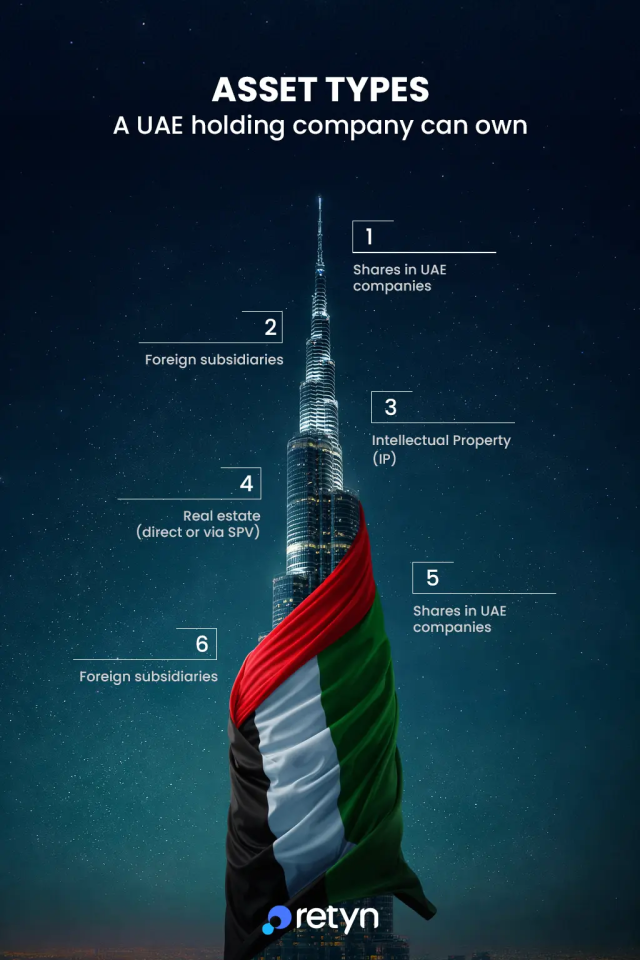
Holding companies cannot "trade" goods. Match your intended assets to the correct activity code:
Investment in Commercial Enterprises
Holding shares in other LLCs or corporations (UAE or Global).
Real Estate Holding
Owning freehold property (requires DLD linkage).
Intellectual Property Holding
Owning patents, trademarks, and collecting royalties.
Mortgage & Solvency
Specialised code for holding debt instruments (Regulated).
Single Family Office
Managing the wealth of a single family lineage (DIFC/DMCC).
Pro tip
A "Holding" activity is strictly passive. If you want to trade goods and hold shares, you generally need a Commercial Licence, not a Holding one.
Step 2: Reserve a trade name
Select a professional name. Note that using words like "Group," "Holding," or "International" often requires proof of existing subsidiaries or a higher share capital requirement.
Quick Fact
Dubai is home to 72,500 millionaires, 212 centi-millionaires and 15 billionaires. Amongst these are families with business interests that benefit from effective structuring.
Prepare 6 months of personal statements and evidence of wealth accumulation to prove funds origin.
Economic Substance
"Pure Holding" entities only require a Registered Office, but "High-Risk IP" holdings require physical staff and premises under ESR.
Structure Chart
Visual diagram of UBOs (Beneficial Owners) is mandatory.
Pro tip
Banks prefer structures where the UBO appears directly on the licence. Complex multi-layered offshore entities (e.g., BVI -> Dubai) face longer compliance checks.
*Costs exclude corporate tax registration and optional physical office space.
Holding Company Cost Estimator (AED)
Estimated setup cost: —
Get detailed breakdown on WhatsApp
Includes basic registration & licence fees.
DIFC/ADGM structures may incur additional Registered Agent or data protection fees.
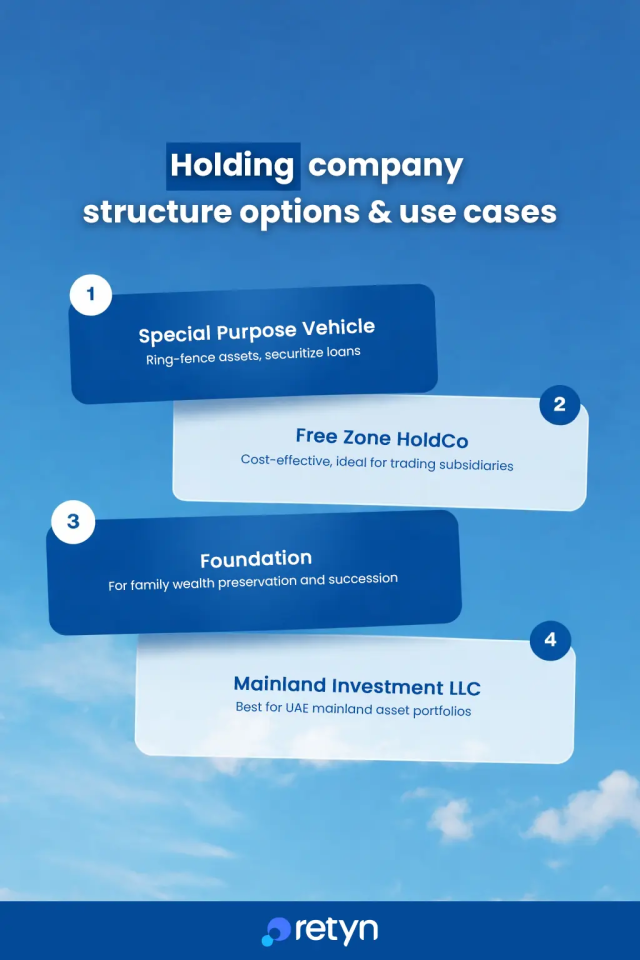
Step 4: Select the right vehicle structure
Your structure determines your asset protection level, succession planning capabilities, and compliance burden:
Passive entity used to ring-fence assets or securitise loans. (Common in DIFC/ADGM).
Free Zone HoldCo
Cost-effective standard company limited by shares. Ideal for holding active trading subsidiaries.
Foundation
Orphan entity (no shareholders) used for family succession and wealth preservation.
Mainland Investment LLC
Best for holding diverse UAE mainland assets or local real estate portfolios.
Pro tip
DIFC "Prescribed Companies" offer lighter compliance reporting and lower fees but are restricted to specific qualifying applicants (e.g., family offices).
Need help structuring your Dubai holding company?
Book a free consultation with our wealth structuring team.
Step 5: Choose your jurisdiction (Civil vs. Common law)
Where you register dictates the legal framework governing your assets, inheritance rules, and dispute resolution.
Financial free zones (Common law)
DIFC and ADGM operate under English Common Law principles. They are the gold standard for international investors and family offices.
Key advantages:
Independent Courts
Disputes settled in English-language courts (DIFC Courts).
Wills & Probate
Ability to register non-Muslim wills for asset succession.
Trust Law
Robust framework for setting up trusts and foundations.
Standard free zones & mainland (Civil Law)
Zones like DMCC, IFZA, and JAFZA, or Mainland DET, follow UAE Civil Law. Excellent for commercial holdings and operational efficiency. Choosing between a free zone company setup and a Dubai mainland company setup centers on the nature of your underlying assets..
Ideal for:
Cost Efficiency
Lower setup and renewal fees compared to DIFC.
Visa Allocation
Easier to grant investor visas to family members.
DTA Access
Full access to UAE's Double Taxation Avoidance treaties.
Quick Fact
The UAE has over 140 Double Taxation Agreements (DTAs). A properly structured mainland or free zone HoldCo can reduce withholding tax on foreign dividends to 0-5%.
Step 6: Submit application & UBO declaration
The application focuses on compliance: proving who the ultimate owners are and the source of their funds.
Application workflow
KYC & Compliance
Submit passports, proof of address, and CVs for all shareholders.
Legal Structuring
Draft the Articles of Association (AoA) defining share classes and voting rights.
UBO Registry
Mandatory declaration of the "Ultimate Beneficial Owner" (Natural person owning >25%).
Lease Agreement
Select a physical office or a "Registered Address" (Flexi-desk) package.
Licence Issuance
Receive the Certificate of Incorporation and Commercial Licence.
Holding company setup - Document checklist
Individual Shareholder
Passport Copy (High resolution)
UAE Visa/Entry Stamp (if applicable)
Proof of Residential Address (Utility bill < 3 months)
Bank Reference Letter or 6-month statement
CV / Professional Profile
Source of Wealth Declaration
Corporate Shareholder
Certificate of Incorporation (Attested)
Memorandum & Articles of Association (Attested)
Board Resolution calling for New Sub-co
Certificate of Incumbency / Good Standing
UBO Declaration for Parent Entity
Parent Company Bank Statements (3-6 months)
Tip: For DIFC/ADGM, all foreign documents must be notarised and legalised (UAE Embassy attestation) in the country of origin.
sequenceDiagram
participant Investor
participant Agent as Corp Service Provider
participant Registrar as Registrar (DET/FZ)
participant Compliance as Compliance Dept
participant Bank
Investor->>Agent: 1 · Submit KYC & Source of Wealth
Agent->>Compliance: 2 · Preliminary Risk Check
Compliance-->>Agent: Approved
Agent->>Registrar: 3 · Name Reservation & Application
Registrar-->>Agent: Initial Approval
Agent->>Investor: 4 · Sign MoA / AoA (Digital)
Agent->>Registrar: 5 · Submit Signed Docs & UBO Data
Registrar-->>Investor: 6 · **Licence & COI Issued**
Investor->>Bank: 7 · Apply for Corporate Account
If your property assets are valued >AED 2M, you may qualify for a 10-Year Golden Visa without needing a separate employment contract from the HoldCo.
Step 8: Open a corporate bank account
This is the most critical step. Passive holding companies are often deemed "High Risk" by retail banks. Preparation is key to passing Enhanced Due Diligence (EDD).
Company Profile
Clear explanation of investment strategy (What are you buying? Where is the money coming from?).
Source of Funds
Personal bank statements of the UBO (6 months) showing liquidity.
Trade licence & MoA – Original / Certified True Copy.
Structure Chart – Signed by UBO, showing % ownership.
Source of Wealth Narrative – Detailed CV + background.
6-Months Bank Statements – Personal account of UBO.
Tenancy Contract – Ejari or Free Zone lease.
Upstream Documents – If owned by another company, full legal docs of parent.
Utility Bill – Proof of address for all shareholders.
Tip: "Shell companies" with no physical presence or clear purpose are often rejected. Ensure your business plan articulates a clear investment roadmap.
Need help structuring your Dubai holding company?
Book a free consultation with our wealth structuring team.
Even passive holding companies must register for Corporate Tax. However, you may aim for exemptions:
Tax Registration Number (TRN)
Mandatory for all UAE companies.
Participation Exemption
0% tax on dividends/capital gains if owning >5% of a subsidiary for >12 months.
ESR Notification
Annual filing to confirm if you conducted "Relevant Activities" (e.g., Lease-Finance, Intellectual Property).
Step 10: Will registration & estate planning
To prevent your Dubai assets from being frozen upon death (under Sharia distribution defaults), non-Muslim investors should register a Will.
DIFC Wills Service
Covers assets across the UAE. English language, common law principles.
Abu Dhabi Civil Wills
Alternative option for non-Muslims to designate beneficiaries.
Expert insight: The "Substance" shift in Dubai’s wealth structuring
The 2026 to 2028 window of wealth structuring in Dubai is hugely defined by three regulatory shifts. These include the full enforcement of Economic Substance Regulations (ESR), the strategic use of the Corporate Tax "Participation Exemption" and the rise of Family Office regulations in DIFC. Definite advantages for investors who move beyond "paper companies" to entities with genuine management control are long-term asset safety and global banking legitimacy.
The five strategic levers mentioned below stretch beyond basic licensing to help new holding company owners maximize asset protection and minimize tax exposure under the new UAE Corporate Tax regime.
Mastering the "Participation Exemption"
As per the UAE Corporate Tax Law, dividends and capital gains are 0% tax-exempt if Participating Interest in a juridical person is at least 5% (or acquisition cost is equal to or exceeds AED 4 million) and is held for a minimum of 12 continuous months.
Strategy: Qualify under Federal Tax Authority (FTAs) entitlement to profits and liquidation proceeds test. Ensure your ownership interest in the Participation entitles you to receive at least 5% of the profits and liquidation proceeds.
Passing the "Mind & Management" Test
The FTA will only issue a UAE Tax Residency Certificate (or claim relief from double taxation) upon satisfying the specific criteria such as physical presence requirements. Simply having a UAE residence permit alone will not suffice.
Action: It is important to demonstrate that your holding company’s management and control truly occurs in the UAE. Appoint UAE-resident directors and hold and document physical board meetings in Dubai. Keep detailed minutes handy to show the key decisions were made there. This can be submitted as proof when applying for a Tax Residency Certificate with foreign tax authorities.
The Foundation + SPV "Double Tier"
High-net-worth individuals are turning to the DIFC Foundations Regime (established under the DIFC Foundations Law No. 3 of 2018) to avail a flexible and modern legal framework for managing and protecting their assets.
Plan: Get a structured approach to preserving your private wealth. DIFC Foundations gives greater control over the distribution of assets across multiple generations (according to the founder's wishes, even after death) and ensures assets are ring-fenced from the founder's personal liabilities.
Banking Credibility via Substance
Tier-1 banks expect entities to show local substance. These UAE banks now reject “shell" holding companies with no clear purpose or genuine business presence in UAE.
Tip: Submit a clear "Investment Memorandum" that meets the bank’s strict KYC requirements. Fill details regarding exactly what you intend to acquire, say for example, acquiring commercial real estate in Business Bay. Such specificity might make account opening faster by weeks and prevent avoidable rejections.
Consolidating Global Assets
Varying regulatory standards make it harder to satisfy international AML/KYC expectations, especially when dealing with banks or institutional investors.
Step: Redomiciling a BVI or Cayman Island entity to the UAE free zone such as DMCC, DIFC, ADGM or RAK ICC, allows you to preserve the legal status, goodwill and operational history while coming under UAE law. The continuity helps holding structures migrate to the UAE without triggering a disposal of their assets and also ensures banking relationships are kept intact. This creates a cleaner compliance profile for future exits or IPOs.
Pro tip
Always archive your Board Resolutions and AGM minutes
digitally. When applying for a Tax Residency Certificate (TRC)
next year, the Federal Tax Authority will demand proof that meetings
actually occurred in Dubai.
Decision snapshot – what to choose, at a glance
Structure / Licence
Legal System
100% Foreign Ownership
Setup Speed
Bank-Account Ease**
Audit Required
Mainland Investment LLC
Civil Law
Yes
≈ 2 weeks
High
No (unless requested)
DIFC Prescribed Co. (SPV)
Common Law
Yes
1-2 weeks
Medium
No (Small co. exempt)
Standard Free Zone HoldCo
Civil Law
Yes
5-7 days
Medium
Zone Dependent
DIFC / ADGM Foundation
Common Law
n/a
2-3 weeks
High (Private Bank)
No
* "Common Law" (DIFC/ADGM) is preferred for complex inheritance planning.
** "Bank-account ease" depends heavily on the clarity of the UBO's source of funds.
If you set up in DIFC or ADGM, you are subject to strict GDPR-aligned Data Protection laws.
Data Protection Commissioner
Register your entity and pay the annual fee (if processing personal data).
Annual Financial Audit
While some SPVs are exempt, most standard Free Zone companies must submit audited financials during renewal.
Pro tip
Ensure your company secretary maintains a physical or digital minute book of all resolutions. This is the first thing auditors ask for.
Risk & penalty matrix – key non-compliance fines
Offence
Fine (AED)
Consequence
Failure to register/update UBO Data
100 000
Licence freeze & Bank account block
Failure to submit ESR Notification
50 000
Notification to tax authority of parent country
Trading commercially on a Holding Licence
50 000+
Licence cancellation & closure
Figures are based on Cabinet Resolution No. (53) of 2021 and recent Ministry of Economy circulars.
Mixing Funds: Using the HoldCo bank account for personal expenses (breaches corporate veil).
Dead Directors: Not having a Power of Attorney or succession plan if the single director passes away.
Paper Companies: Registering without any "Economic Substance" (no address, no directors), leading to tax penalties.
Crypto Trading: Trying to trade crypto assets under a standard "Investment in Commercial Enterprises" code (requires VARA approval).
Regulation & news updates for holding companies · 2026
TaxUAE clarifies corporate tax treatment for family wealth management structures - 19 September 2025
Updates on corporate tax application for family wealth management, including holding companies, SPVs and single and multi-family offices.
ComplianceFTA reiterates 9-month deadline for corporate tax returns and payments - 27 August 2025
MoF reminds registrants to file CT returns and settle tax within nine months from the end of the relevant Tax Period to avoid administrative penalties.
ComplianceFTA reminds companies of 7-year record retention requirement - 27 August 2025
Taxable and Exempt Persons must retain financial records for a minimum period of seven years after the end of the relevant Tax Period.
ComplianceFTA highlights the use of EmaraTax platform for corporate tax compliance - 27 August 2025
Corporate Tax registration, return filing, and tax payments can be completed digitally through the EmaraTax, offering 24/7 access to tax services.
TaxUAE expands corporate tax exemption to foreign entities owned by exempt persons - 20 May 2025
MoF expanded corporate tax exemptions to include certain foreign entities and harmonize the tax treatment of local and foreign structures.
TaxUAE updates corporate tax rules for partnerships and family foundations - 7 January 2025
Administrative relief, compliance burdens and tax clarity introduced for unincorporated partnerships, foreign partnerships and family foundations.
Glossary of acronyms
UBO – Ultimate Beneficial Owner
SPV – Special Purpose Vehicle
ESR – Economic Substance Regulations
DTA – Double Taxation Agreement
MoA – Memorandum of Association
CT – Corporate Tax (9%)
FAQs on securing a holding company licence in Dubai
No. A holding company licence in Dubai is solely for owning assets. It does not permit a company to sell products or services. Trading outside of the terms of your licence could result in regulatory non-compliance and serious banking consequences including account restriction and closure.
Banks classify holding companies as high risk because they are largely considered to be passive entities that have limited to no operational activity. In addition, this makes it difficult for banks to understand transaction flows, business purpose and source of funds for these types of companies. As a result, banks apply enhanced due diligence and require greater transparency regarding ownership, source of wealth and intended use of funds.
Generally, no. Under the UAE Corporate Tax Participation Exemption dividends and capital gains received by a UAE holding company from its domestic or foreign subsidiaries may be exempt from the 9% corporate tax if all the following conditions have been met.
The UAE holding company owns at least 5% of the subsidiary
The shares have been held (or are intended to be held) for at least 12 months.
The subsidiary is an operating business that pays corporate tax or is a publicly listed company.
The group structure was established for genuine commercial reasons and not solely to reduce tax.
Yes. You can obtain a UAE Golden Visa via a holding company in Dubai as a business investor or shareholder. The requirements to meet this include your holding company having a minimum of AED 2 million worth of shareholding value or paid-up capital that is verified by audited financial statements or by bank confirmation. You will also need to have ownership or shares in the holding company and a current UAE trade licence. When all of the above are satisfied, you will be able to submit an application for a 10-year renewable Golden Visa allowing long-term residence and family sponsorship in the UAE.
There is a key distinction when it comes to succession and legacy planning. A standard holding company will have shareholders and shares. Therefore, if the shareholders pass away, the assets owned by that holding company may be subject to probate and, in certain cases, the local inheritance laws. A DIFC Foundation, however, will have no shareholders and will be an independent legal entity created to own assets for the benefit of specific purposes or beneficiaries. This is because the beneficial interest in a DIFC Foundation does not automatically transfer on death as DIFC Foundations are often utilized as a means to achieve continuity of assets and structured wealth planning across generations.
If your business activity qualifies as an Equity Holding and you generate only dividends or capital gains then typically a flexi-desk, co-working space or shared office will be sufficient to meet the requirements of ESR. On the other hand, if your business generates interest, royalty or lease income, then you must provide evidence of adequate economic substance such as having a local presence (for example, physical premises in the UAE), employing staff or using UAE-based outsourced resources (i.e., accounting services, marketing etc.) and also provide evidence that your main income-generating activities occur within the UAE.
The annual renewal fees for a business in Dubai vary based upon jurisdiction and structure:
DIFC Prescribed Company (SPV): Approximately USD 1,000 per year for the authority fee plus registered agent fees.
Standard free zone or mainland companies: Annual cost range between AED 12,000 and AED 15,000 depending on the jurisdiction.
Additional expenses to consider:
Annual ESR filing
Preparing a Corporate Tax return
Disclaimer: This content is for information only and does not constitute legal or tax advice. Regulations change — always consult a qualified corporate service provider.
Need help structuring your Dubai holding company?
Book a free consultation with our wealth structuring team.